
Transcript
Announcer:
Welcome to CME on ReachMD. This activity is provided by Prova Education. This episode is part of our MinuteCE curriculum.
Prior to beginning the activity, please be sure to review the faculty and commercial support disclosure statements as well as the learning objectives.
Dr. Bril:
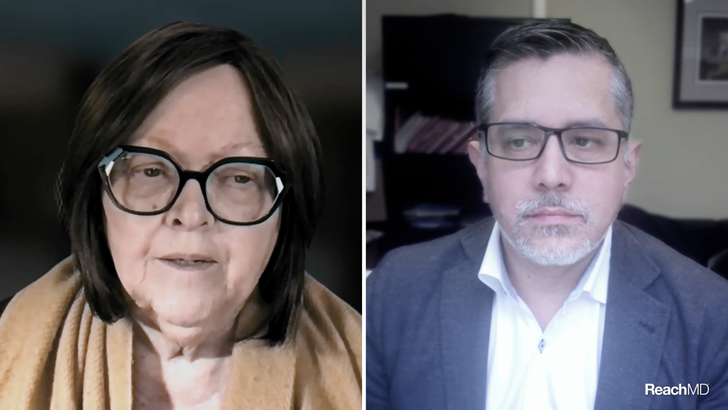
This is CME on ReachMD, and I'm Dr. Vera Bril. Here with me today is Dr. Hans Katzberg.
Dr. Katzberg, can you describe the evolution of gMG, inclusive of ocular and generalized MG, for our learners?
Dr. Katzberg:
Thank you very much, Dr. Bril. I would say that ocular symptoms are actually very common early on in the disease course for myasthenia gravis. And in fact, some of these symptoms, which include ptosis, diplopia, and blurry vision, can be some of the hallmarks of diagnosis in MG. And although these can be present early, they can often persist throughout the disease, even in later stages. And I think the thing that one wants to look out for is the evolution of this to more generalized symptoms.
If symptoms maintain in the eyes over, I would say, a number of years, particularly after 2 years, then one may consider the patient as a case of ocular myasthenia gravis, where it maintains in the eyes. However, early on, evolution can happen, and one has to be attuned to symptoms outside the ocular system, such as bulbar symptoms or generalized symptoms.
It may be very difficult to predict who will go from ocular to generalized myasthenia. Some of the risk factors could include the presence of antibodies, so the acetylcholine receptor antibody, although that can be seen in pure ocular myasthenia, that may suggest that someone may be at high risk for generalization.
It's also important to treat the symptoms of myasthenia, regardless of when they occur in order to help the patient. So treating with some of the corticosteroids or other immune suppressant agents can be helpful and also be helpful to mitigate and prevent generalization. There is some evidence that that can also be helpful in preventing extra symptoms outside the ocular symptoms.
However, it's important to note that it's difficult to tell within any given patient when or how this might occur, so one has to be very attuned to this and continue to follow patients closely, exam them outside the ocular system, and tell them that they may be at risk for generalization in the first couple of years after the onset of symptoms.
Dr. Bril:
Thank you, Dr. Katzberg. I'd like to say that MG is such an unpredictable disease. And I do recall a patient that I had with ocular MG who did not generalize until about 20 years after initial presentation. So although the truism is that usually the disease gets worse within the first 2 years of onset, that's not always the finding, and you cannot really relax very well and think that the patient will never generalize, because it's unpredictable as to who will generalize.
Steroids do lower the risk of generalization from ocular to generalized MG but do not absolutely prevent the generalization. And we don't know all the factors that lead to the spread of the disease outside of the eye muscles. The eye muscles are particularly sensitive because of the ratio of muscle fibers to nerve fibers in the eye. That is the thinking behind it, and perhaps the receptors, acetylcholine receptors, but really we don't understand the exact progression.
And the progression isn't the same in every patient. The presentation can be ocular or non-ocular, and then you may get involvement of different structures. So we don't understand all of this in our MG patients but must be alert to the spread because of the possible complications such as myasthenic crises.
With that, our time is up. Thanks for a great discussion, Dr. Katzberg. And thanks to our audience for tuning in.
Announcer:
You have been listening to CME on ReachMD. This activity is provided by Prova Education and is part of our MinuteCE curriculum.
To receive your free CME credit, or to download this activity, go to ReachMD.com/CME. Thank you for listening.

